Monasticism emerged from a deep impulse to withdraw—a radical pursuit of spirituality and transcendence. The word itself comes from the Greek μόνος (mónos), meaning “alone,” reflecting the ideal of the holy hermit who retreats from the world to dedicate life entirely to the divine. By the late 3rd century, in Egypt and Palestine, the first Christian monks began to follow this path, creating ways of life that would later give rise to a distinct architecture centered on seclusion.
Natatorium of Southeast University / SEU-ARCH Zhou Qi Studio. Image Courtesy of SEU-ARCH Zhou Qi Studio
Sports infrastructure has become an important aspect of contemporary life, addressing the growing need for physical activity and leisure spaces to offset the stresses of urban living. In this context, architecture, particularly in the realm of sports facilities, plays a pivotal role in shaping these environments. Sports architecture, in particular, has evolved into a highly specialized discipline that not only addresses the functional and technical aspects—such as structural integrity, safety standards, and the specific requirements of different sports—but also emphasizes the importance of thoughtful design. A well-designed sports facility not only enhances the user experience but also integrates seamlessly into its urban or natural surroundings, contributing to the overall aesthetic and social value of the space. By blending functionality with innovation and creativity, sports architecture has the potential to positively impact both individual well-being and community cohesion.
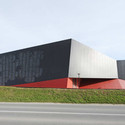
Designed by Enota, their just completed Traffic Circle in Podčetrtek marks the entrance to the dark monolithic volume of the municipal sports hall on one and the thermal spa complex on the other side of the regional road. With a primary intent to slow down the traffic in this consequently very busy area, the main accesses to both complexes also connect to the traffic circle. Its design also suggests a tectonic shift that has caused the road surface to bloat and belched out the massive blocks. More images and architects’ description after the break.
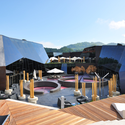
The project proposal for the new Terme Olimia wellness spa, designed by Enota, is located in the very center of a well-known ski resort, Kranjska Gora in Slovenia. With rethinking the local building characteristics completely, the new spa building exhibits attractive design and despite its distinctive and extensive program maintains the town’s unified look. More images and architects’ description after the break.
Architects at Enota have shared with ArchDaily their recent competition entry, a “natural experience” hotel resort in Bled, Slovenia, entitled ‘Mivka’. For additional images of their design as well as descriptive text from the architects themselves, please follow after the jump.
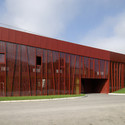
Enota has been awarded first prize for the renovation of the Dominican Monastary into a Performance Center located in the western most part of the historical center of Ptruj, Slovania on the embankment of the Dvara River.
Slovenian architects Enota shared with us “Lotus Towers”, a 64,100 m2 housing project in Ljubljana, for which they received second prize in an invited competition. More images and architect’s description after the break.
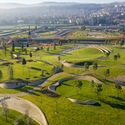
Slovenia-based Enota shared with us their project Velenje Sports Park, for which they received first prize in an open competition. More images and architect’s description after the break.