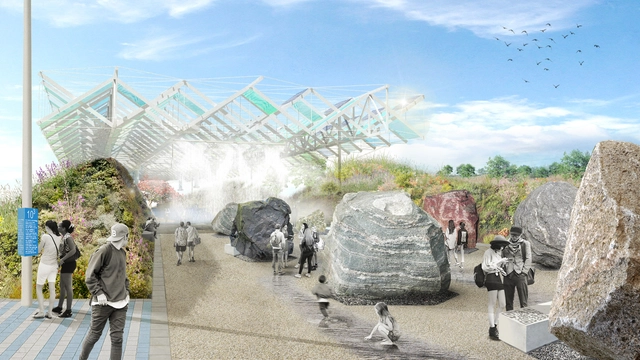
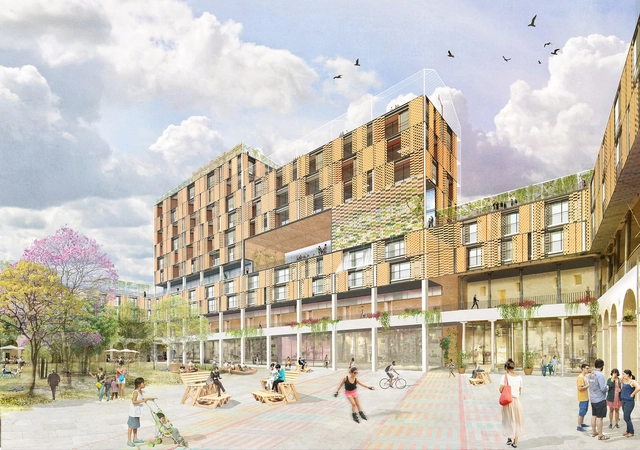
Ecosistema Urbano, after winning a public competition, has developed the Landscape Design Project for the Louis Pasteur Boulevard and the main public spaces of the Teatinos University Campus in Málaga, Spain.
The project presents a new campus that is both open to the natural landscape and digitally connected, allowing users to interact, view real-time information, and adapt various public space elements to their needs, including the configuration of bioclimatic conditioning systems.
Ecosistema Urbano, one of the winners of the J. Irwin and Xenia S. Miller Prize, has proposed Cloudroom as part of the 2021 edition of Exhibit Columbus in Columbus, Indiana. The installation seeks to rethink public spaces for education by raising awareness about today's environmental challenges. Floating above a wooden structure on Central Middle School's lawn, this inflatable cloud creates a community space with a shaded microclimate for learning, playing, and sharing. By fostering new learning methodologies through direct experience, it offers a welcoming environment suitable for various activities bridging the school and public space.
An ecological approach and a social focus are the two pillars of Cloudroom, an installation designed in collaboration with the students and staff of Central Middle School. The project responds to the theme “NewMiddles: From Main Street To Megalopolis, What Is The Future of The Middle City?", proposed by curators Iker Gil and Mimi Zeiger.
Spanish firm Ecosistema Urbano has presented details of Febres Cordero, one of the first projects in Cuenca, Ecuador, to emerge from the Cuenca RED initiative. This iconic, historic building, which served as a school for decades, is being transformed into a mixed-use development that will serve as a benchmark for economic, environmental, and social sustainability in the city.
Developed under the ICES (Emerging and Sustainable Cities Initiative) program of the Inter-American Development Bank, in collaboration with the Municipality of Cuenca, Cuenca RED is an initiative for which Ecosistema Urbano has proposed programs and activities to establish a new network of reactivated public spaces within the historic center of the city, a UNESCO World Heritage site since 1999.
During the recent XIX Architecture Biennial of Chile, we spoke with Spanish architect José Luis Vallejo, co-founder of Ecosistema Urbano. The Columbia GSAPP academic reflected on addressing the problems of the contemporary city through new horizontal citizen participation tools that can offer solutions tailored to the dynamic, constantly changing reality of our urban environments.
Vallejo is critical of the education and current role of architecture schools in addressing the real-world problems of cities and society. "Our academic training was highly disciplinary; interestingly, 20 years later, in a society that has changed radically, it remains exactly the same environment in which architects are still being educated," he comments.
https://www.archdaily.com/1114406/jose-luis-vallejo-the-training-of-the-architect-remains-the-same-even-though-society-has-changedJavier García Librero
MVRDV's shortlisted design for the Shift Landmark competition, 2026. Image Courtesy of MVRDV
Shift, a company offering digital programs to reduce carbon emissions through individual behavior change, has announced the five finalist teams advancing to Stage Two of its international architecture competition. Launched in January 2025, the Shift International Architecture Competition called for proposals to design "the Shift Landmark": a 25,000 to 30,000 m² building in Waterkant, a new waterfront district in southern Rotterdam. The project includes a hotel, a conference and meeting center, and a sustainable food court. Its objective is to set a new standard for a purpose-driven destination that turns circular living into "something individuals, companies, and organisations can feel, experience, and act on." The five shortlisted design concepts reflect different visions of sustainability and climate action, developed by teams led by the European offices of MVRDV (Netherlands), Heatherwick Studio (United Kingdom), Office for Political Innovation (Spain), Mecanoo (Netherlands), and Ecosistema Urbano (Spain).
El caso de Sieger Suarez y Arquitectonica en Miami, Estados Unidos. Image Cortesía de Mitch Tuchman. Imágenes: U.S. District Court for the Southern District of Florida, Miami Division
The Chilean lawyer, Juan Pablo Klenner, has dedicated himself to investigating one of the most discussed and least in-depth topics in architecture: copyright in our discipline. Plagiarism, referents or inspirations? It is a discussion that surely falls on deaf ears every time we talk about it among ourselves, but in the legal world it is clearly very well developed. If for some people creativity should not be measured in these terms, for others it is an issue that can go to court.
Following the publication of his book "Architecture too. Copyright for Architects", we talked to Klenner about what we have always wanted to know, but never dared to ask. "The idea of total originality must be rejected, no one is capable of creating something out of nothing, even in the work with the least external influences," he warns.