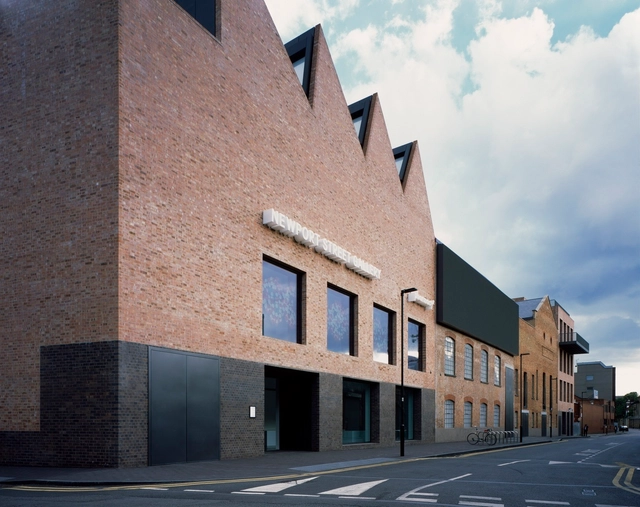
Designed as a free public gallery to house artist Damien Hirst’s private art collection, Caruso St John’s scheme sandwiches three restored Victorian-era industrial buildings between two new structures, one of which features a distinct saw-tooth roof.
"This highly accomplished and expertly detailed art gallery is a bold and confident contribution to the best of UK architecture. Caruso St John’s approach to conservation is irreverent yet sensitive and achieves a clever solution that expresses a poetic juxtaposition of old and new," said the jury in their citation.
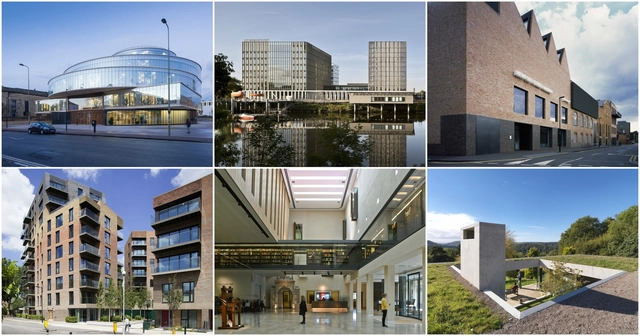
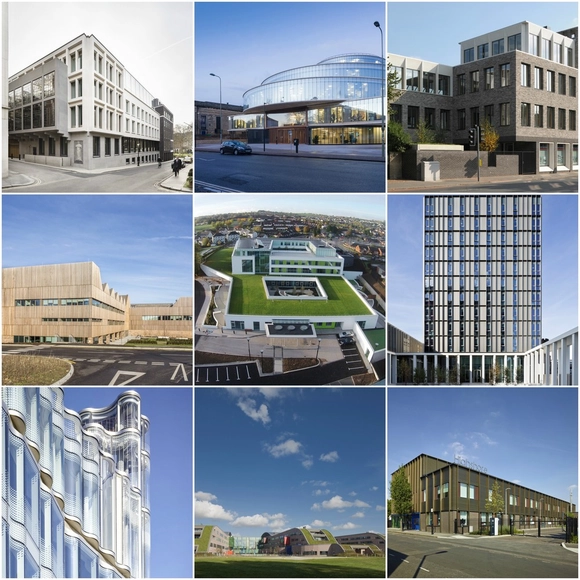
The Royal Institute of British Architects (RIBA) has announced six projects that will compete for the 2016 Stirling Prize, the award for the building that has made the greatest contribution to British architecture in the first year. Selected from the pool of regional winners around the country, the shortlisted buildings range from a small house in the south of England to a new college campus in Glasgow, Scotland. However, in a first for the Stirling Prize, the shortlist features two buildings coming from one client, Oxford University.
"Every one of the six buildings shortlisted today illustrates the huge benefit that well-designed buildings can bring to people’s lives," said RIBA President Jane Duncan. "With the dominance of university and further education buildings on the shortlist, it is clear that quality architecture’s main patrons this year are from the education sector. I commend these enlightened clients and supporters who have bestowed such remarkable education buildings."
The winner of the Stirling Prize will be announced on Thursday 6 October.
From a shortlist of 68 buildings, 36 London projects have been awarded the 2016 RIBA LondonAwards for architectural excellence, the city's most prestigious design honor. The winners include a home for ravens, a Japanese-inspired London terrace home and a historical restoration. All of these designs will be further considered for the RIBA National Awards, to be announced in July. The winners of the national award will then create a shortlist for the RIBA Stirling Prize – the highest award for architecture in the UK.
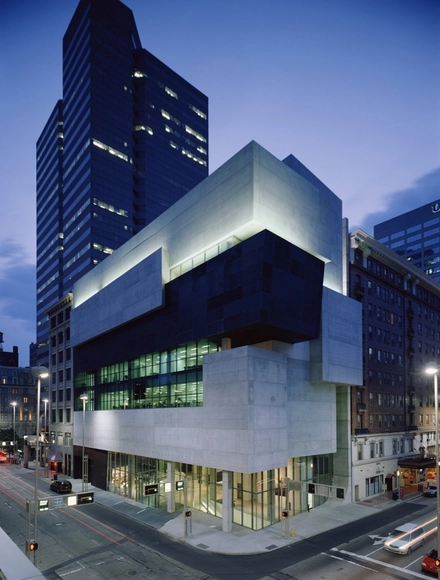
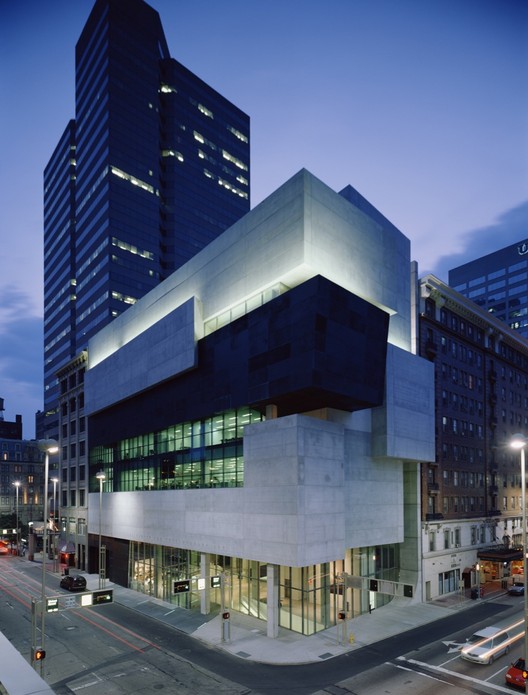
The belief that a building can both blend in and stand out at the same time is embodied by the Lois and Richard Rosenthal Center for Contemporary Art (CAC), located in Cincinnati. Though it's heavy volumetric massing makes it appear as an independent and impenetrable sculptural element, the Rosenthal Center is in fact designed to pull the city in – past its walls and up, toward the sky. This inherent dynamism is well-suited to a gallery which does not hold a permanent collection, and is situated at the heart of a thriving Midwestern city.
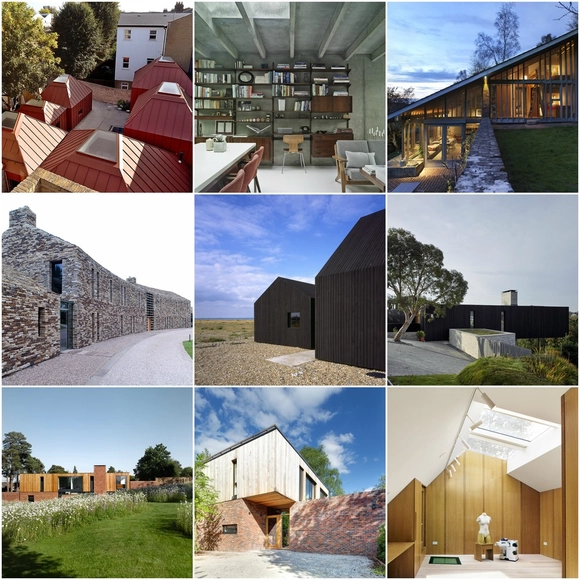
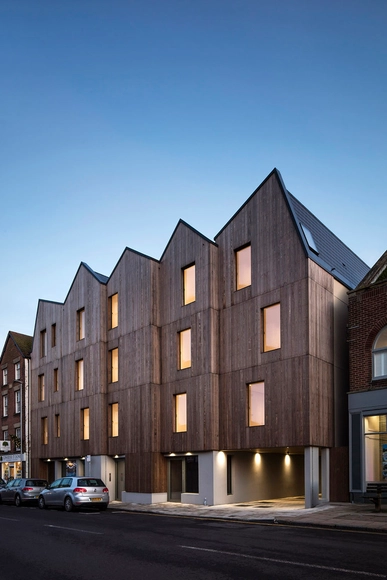
The Royal Institute of British Architects (RIBA) has announced six winners for its RIBA South East Awards, which recognize architectural excellence in the regions of Kent, Surrey, East Sussex, West Sussex and the Channel Islands. These winners will be considered for a RIBA National Award, which will be announced on June 23. Winners of the National Award will then be eligible for the RIBA Stirling Prize later in the year.
The six winners of the RIBA South East Awards are:
Concrete has long had a close relationship with the earth; as the favorite material for the creation of building foundations, one of its most common uses is effectively as a more reliable replacement for soil. In the twentieth century, concrete’s ability to transform our interaction with the ground was taken to the next step. As architects and engineers explored the opportunities offered by a combination of reinforced concrete and the modernist mindset, multiple attempts were made to replace the ground in a more dramatic way: by creating a new ground, separated from the earth itself. Most widespread among these plans was the engineer’s elevated highway which emerged worldwide, and the most relevant to architects the “streets in the sky” embodied by developments such as the Smithsons’ Robin Hood Gardens. Newcastle-upon-Tyne offers a city-wide example of this theory, embarking on an ambitious plan to become the “Brasilia of the North” by creating an elevated network of pedestrian routes entirely separated from the automobiles below - though the project was abandoned in the 1970s with only small sections implemented.
After Modernism’s dramatic fall from grace in the 1970s and 80s, this project to reinterpret the ground with concrete was largely forgotten. Of course architects still used concrete in their designs, but they were content with a purely traditional relationship to the ground: their buildings were discrete entities which sat upon the earth, and nothing more. However, as explored at length in Stan Allen and Marc McQuade’s 2011 book Landform Building: Architecture's New Terrain, recent years have shown architects willing to work upon the ground once again, in new and exciting ways. In the years since Landform Building’s publication, this trend has only intensified, as demonstrated by the following three projects.
The Royal Institute of British Architects (RIBA) have revealed that Dame Zaha Hadid will receive the 2016 Royal Gold Medal — the first sole woman to be awarded the UK's highest honour for architects in her own right. Previous female winners (Sheila O’Donnell in 2015, Patty Hopkins in 1994, and Ray Eames in 1979) were each recognised alongside their husbands and practice partners.
Given in recognition of a lifetime’s work, the RIBA Royal Gold Medal is approved personally by Her Majesty The Queen and is awarded to those who have had a significant influence "either directly or indirectly on the advancement of architecture." Other notable Royal Gold Medallists include Frank Gehry (2000), Lord Norman Foster, Baron of Thames Bank (1983), Ludwig Mies van der Rohe (1959), Le Corbusier (1953), and Frank Lloyd Wright (1941). The medallists' names are engraved into the marble wall at the RIBA's headquarters in London.
According to the Architects' Journal Jonathan Woolf, "the much-respected architect and academic" born and based in London, has died aged 54. His practice, Jonathan Woolf Architects, was established in 1990 and has completed more than thirty-five projects in Europe and Africa. Woolf was also a prolific educator, having taught at the British universities of Bath, Kingston (from which he received an honorary doctorate earlier this year), the Scott Sutherland School of Architecture, and the Architectural Association.
In the wake of her selection as the recipient of the Julius Shulman Institute Excellence in Photography Award for 2015, Hélène Binet's work will be exhibited at the Woodbury University Hollywood (WUHO) Gallery in Los Angeles, California. The exhibition, entitled Hélène Binet: Fragments of Light, will be open from February 28, 2015 to March 29, 2015, showcasing the highlights of the artist's career as a renowned architectural photographer. The exhibition will be initiated with an opening reception and award ceremony on February 28, 2015 to honor Binet for her achievements.
The question of whether the traditional museum survive in the digital age has been bounced around since the dawn of digital art and archiving. In an article for The Independent, Christopher Beanland examines the issue of a global "museum boom" (especially in China where a new one opens every day), and how this is having an undoubtedly positive impact on people's quality of life. For Beanland, it's curious that "we don't splash out on council houses or universities or hospitals any more – but we do build museums and galleries." Perhaps it's because they are "a reliquary for our collective memories" and "a triumph of our collective will" or, in most cases, because they employ excellent PR and branding strategies. He notes that "despite being swamped by possessions, we've changed our views towards those things. In the second half of the 20th century, people defined themselves by what they had. But today people increasingly define themselves by what they do."




.jpg?1462559836&format=webp&width=230&height=230&crop=true)
.jpg?1462560115&format=webp&width=230&height=230&crop=true)







.jpg?1445874627&format=webp&width=640&height=580)


.jpg?1445874627)