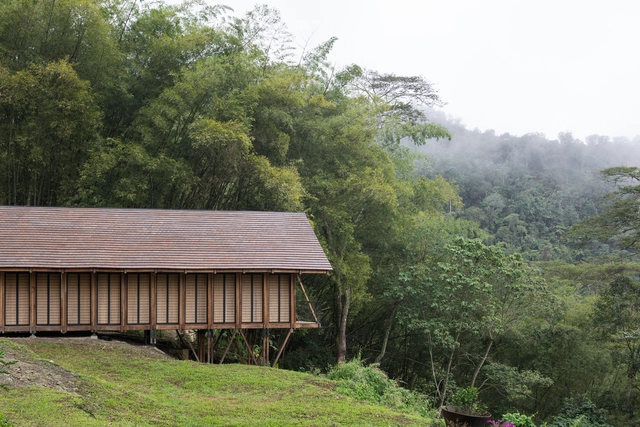
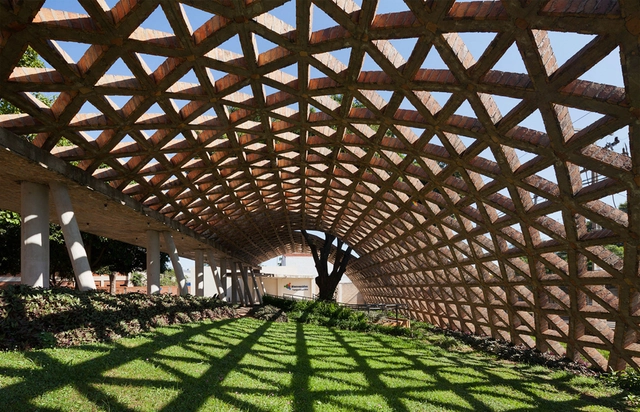
Colombian artist and architect Santiago Pradilla captured my interest through his many passionate pursuits—he has dedicated as much of his life to traveling to and working within small, rural communities and as he has to producing architecture that tells the rich history of Colombian cities.
We discussed the relationship between academia, auto-construction, and rural living as well as the exploration of other artistic disciplines. We even breached the topic of the importance of heritage and projections about the direction of Colombian architecture.
The focus of buildings should ultimately be the well-being of the people using them. When we think of our experiences in hospitals, clinics, the dentist's office, and other medical facilities, the feeling is rarely pleasant. Perhaps it's the smells, the dull, monotone colors, or the sound of medical gadgets working away on some unlucky patient.
Is it possible for a structure to reflect the thoughts of an architect? In the area of architecture, it's a well-known fact that the design process is largely shaped by the client, their culture, their requirements, and their budget, with little attention given to the personal tastes of the architects themselves.
Paraguay’s architecture radically transformed in the last century. For much of the country’s history, indigenous Guarani culture was the primary influence on the built environment. Later, colonialism would shape its cities and settlements. Today, the landlocked country has begun finding new ways to build upon its past, showcasing how residential design can break from tradition.
Relatively unknown outside his home country, Clorindo Testa (December 10, 1923 – April 11, 2013) was one of Argentina’s most important 20th-century architects. Consistently defying categorization, Testa had a hand in two of Buenos Aires’ most iconic buildings, the Bank of London and South America, and the National Library, as well as many others throughout his long career. Characteristically enigmatic, Testa would only ever acknowledge Le Corbusier as an influence, saying, “I never paid attention to other architects.” As a former colleague Juan Fontana described, Testa spoke the language of brutalism with an Argentine accent.








.jpg?1586908171&format=webp&width=230&height=230&crop=true)
.jpg?1586907956&format=webp&width=230&height=230&crop=true)
.jpg?1586908151&format=webp&width=230&height=230&crop=true)
.jpg?1586904288&format=webp&width=230&height=230&crop=true)

.jpg?1584562108)
.jpg?1584562094&format=webp&width=230&height=230&crop=true)
.jpg?1584562122&format=webp&width=230&height=230&crop=true)
.jpg?1584562133&format=webp&width=230&height=230&crop=true)
.jpg?1584562171&format=webp&width=230&height=230&crop=true)













.jpg?1575432754&format=webp&width=640&height=580)
.jpg?1575431947&format=webp&width=230&height=230&crop=true)
.jpg?1575431869&format=webp&width=230&height=230&crop=true)
.jpg?1575432862&format=webp&width=230&height=230&crop=true)
.jpg?1575433082&format=webp&width=230&height=230&crop=true)
.jpg?1575432754)