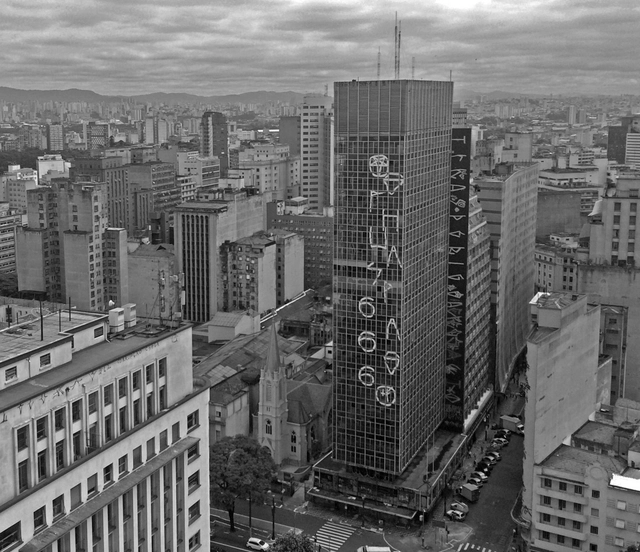
At least two major avenues (23 de Maio and 9 de Julho) mark the footprint of the 1932 Constitutionalist Revolution in the city. Yet, across the capital's landscape, numerous other sites evoke the memory of an armed conflict that became the defining myth of São Paulo's history, commemorated as a state holiday since 1997.
The collapse of the Wilton Paes de Almeida Building on May 1, 2018, exposed a glaring housing emergency. Compounding the cuts in public funding for the sector, in São Paulo alone during 2017, at least 14,000 families were evicted from their homes, and at least another 30,000 face displacement due to public works projects, according to the Eviction Observatory of the Faculty of Architecture and Urbanism (FAU/USP).
All the marketing surrounding smart cities—and there is plenty of it, since behind them are large corporations selling technology to municipal governments—speaks of humane and democratic cities, driven by the potential for citizen interaction with the government and how this can improve the responsiveness of public policies.
Yet, what we are actually seeing is quite different. So-called data mining powers targeted marketing; in other words, by tracking a user's online activity, it is possible to map their preferences. Thus, by appropriating the data we generate (without paying us for it!), companies bombard us with tailored advertisements. Almost everyone has experienced this: after searching for something online, you spend weeks receiving ads for that very item. While this is already an appropriation of the private data of the many for the business of the few, it becomes even more problematic when public information systems—such as police, judicial, and other records—are integrated into these platforms. And this has already begun to happen in China.
Since the beginning of the pandemic in Brazil, there has been much debate regarding its impacts on different territories and social groups. This is crucial for both identifying the best ways to prevent the spread of the disease and protecting those who are most vulnerable. However, the way information and data have been released does not help analyze the territorial impacts and spatial spread of the pandemic, which also hinders efforts to address it.
In the city of São Paulo, the scale of analysis for the pandemic is still the district level, which corresponds to massive portions of the territory with populations larger than many medium-sized cities. This oversimplified view ignores the territorial heterogeneities and inequalities within the city. As we have previously pointed out, the territorial dimension is unfortunately not being properly considered, giving rise to a simplified and even stigmatized reading, such as the claim that “where there are favelas, there is a pandemic.”
Simply moving through Brazilian cities, wasting hours in traffic jams or waiting for overcrowded buses or subways—or ones that don't even exist!—is enough to see that they are far from functioning at a reasonable standard. And even those who, supposedly protected by walls, rarely come into contact with the precarious housing conditions of millions of families are shocked by the growing number of people living on the streets or by stark reminders of this precarity when a tragedy, such as the fire in the Wilton Paes de Almeida Building, hits the headlines. One would expect, therefore, that urban issues—housing and transportation in particular—would be prominent in the government platforms of the presidential candidates.
Videos
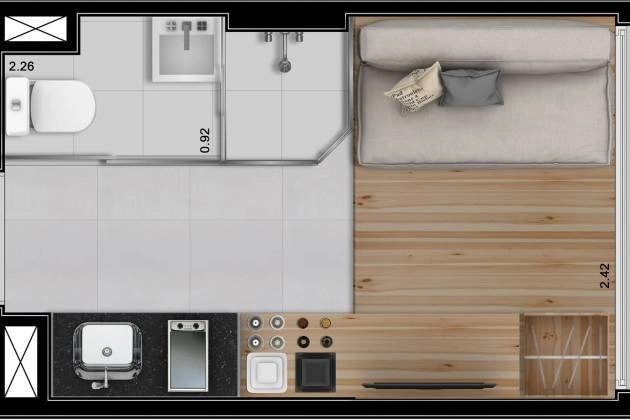
Floor Plan of the 10m² apartment in downtown São Paulo. Image via Raquel Rolnik's blog.
The launch of a building in downtown São Paulo - Brazil was the talk of the town due to its surprising apartment sizes of only 10 square meters. This raised the debate about the market trend to produce ever smaller properties and the ability of these properties to meet the needs of its residents.
There is no doubt that, this type of real estate is related to newest trends of family compositions. It is increasingly common for residences to be occupied by only one person, or at most two. According to data from the SEADE Foundation for 2010, in the State of São Paulo, almost 40% of households have these characteristic, 13% of which is made up of a single resident.