Today, discussing infrastructure means discussing geopolitics and connectivity as a key driver of global competitiveness. Connectivity, however, should not be understood solely as physical infrastructure, even if we are talking about roads for autonomous vehicles or hyperloop tunnels.
For the past year, I have been in conversation with architects and designers who are involved in the creation of immersive environments. They see themselves as naturally responsible for leading the construction of these environments, and this should serve as a reminder that architects have the potential to take on this role.
Despite how obvious it might sound, the metaverse has mostly been designed by developers and graphic designers, Therefore, it should work as a wake-up call for architects to be involved since they have skills particularly apt for it.
Whether the metaverse can be utilized as a narrative to claim a changing role for architects remains to be seen, but 2023 could be the year.

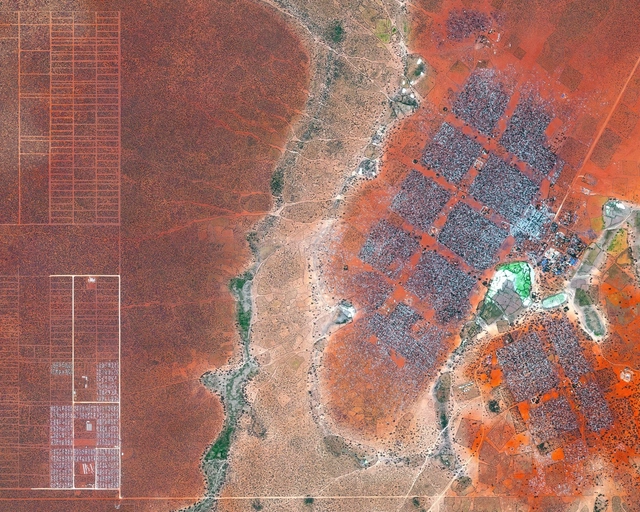
Refugee camp in Dadaab, Northeast Kenya. Created by @benjaminrgrant, source imagery: @digitalglobe. Image
What do Katuma, Hagadera, Dagahaley, Zaatari or Ifo bring to mind? They are truly beautiful names, and could easily belong to Italo Calvino's 55 invisible cities.
But they are not invisible cities, they are informal settlements in Kenya and Jordan, home to between 66,000 and 190,000 refugees, mostly from bordering countries, supposedly temporary camps that half a century later are still with us today. Generally lacking in infrastructure, some have schools and hospitals, and Zaatari even has a circus academy, but for most of the people who live there, they are the only cities they have ever known.