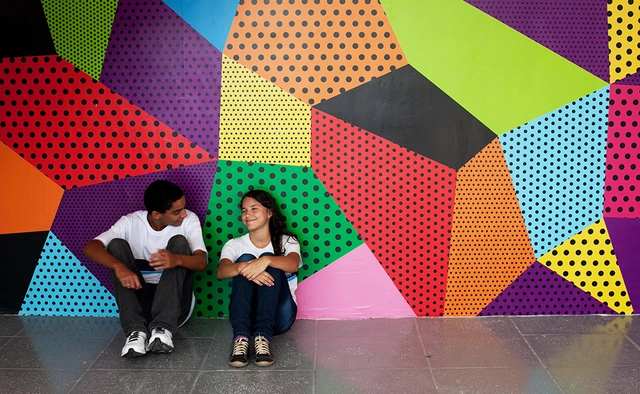
GENTE – Experimental Gymnasium of New Educational Technologies, located at the André Urani school, in the Rocinha community (RJ). Photo credit: Agência Grupo do Rio.
Over 469 years after the construction of the first Brazilian school—built in Salvador, Bahia, by Jesuits who taught reading, writing, arithmetic, and Catholic doctrine—school architecture remains indistinguishable within the urban fabric of most Brazilian cities. Characterless and rigid buildings, unable to connect with their surroundings due to enclosing walls, were once described by architect Mayumi Souza Lima as "structures [that] could just as easily be meant for children, bags of beans, or cars, since they are merely covered areas, with a ceiling and a floor."
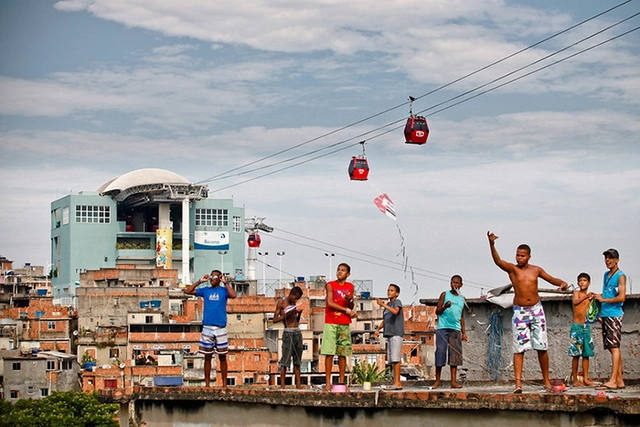
Since the beginning of the pandemic, educator Camila Regina and cartographer Henrique Lima have noticed a significant increase in kites in the skies over Rio de Janeiro's peripheral neighborhoods. These colorful paper diamonds and deltoids are guided by the hands of children and adults who cannot leave their homes, but can go up to their rooftops to fly kites.
Inspired by this reclaiming of the skies and their own histories with kites, the two kite flyers founded Pipasgrafias, a multimedia project about the activity. Video, text, and illustrated stories—along with an interactive map—portray what it is like to fly a kite in Rio's various peripheral neighborhoods.
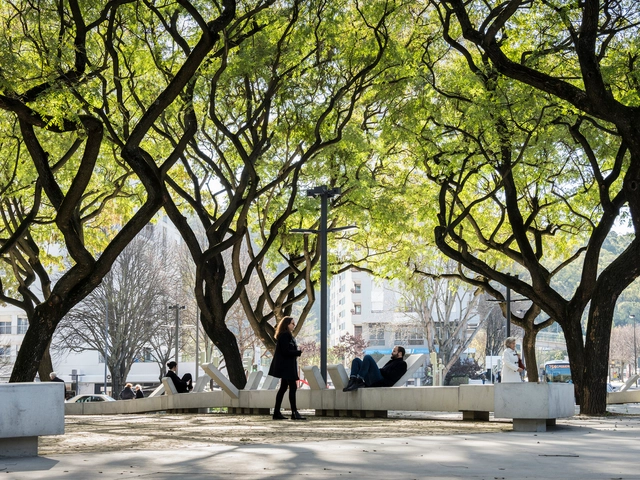
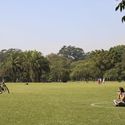
This June, the Global Cities program of the University of São Paulo (USP) carried out the research Emoções Momentâneas (lit. Momentary Emotions) to measure how the pandemic was changing the relationship of individuals with public spaces in São Paulo. Among the collected data, there was one that caught the attention of the group of researchers: 86% of the surveyed people wanted to spend time in green environments such as parks and squares.
"The research indicates a desire for reconciliation with the public space," explains architect Deize Sanches, one of the people involved in the research. "A desire to see the potential of green spaces to improve the quality of life in a way that was not being experienced before the pandemic."
In 2018, sociologist and cycling activist Marina Harkot defended her master's thesis Bicycles and Women at the University of São Paulo (USP). To develop a qualitative methodology examining the challenges faced by female cyclists in the city, she interviewed various women: those who bike to work, those who explore the city on two wheels, and those who love tackling the capital's rolling topography.
Her methodology succeeded in revealing a common thread among these diverse cyclists: “It is the network surrounding these women that seems to prompt them to start cycling and keep them riding — as well as female role models, the women (whether known to them or not) who ride and inspired them,” wrote the researcher.
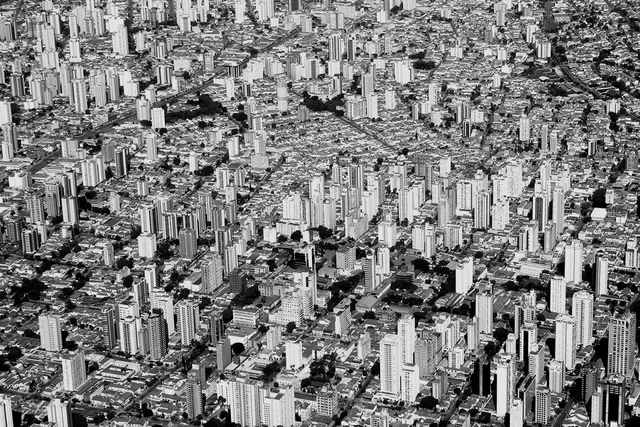
São Paulo. Photo by Fernando Stankuns, via Visualhunt / CC BY-NC-SA
On October 29, the 2020 Inequality Map was launched virtually. Produced by Rede Nossa São Paulo and the Cidades Sustentáveis program, the study maps indicators such as mobility, human rights, education, and health across the city's 96 districts.
Although the mapping was conducted using pre-pandemic data, the goal is for the information to guide the development of public policies to mitigate inequality indicators, which have been exacerbated by the COVID-19 pandemic.
In the Historic Center of Olinda, a Brazilian municipality in the state of Pernambuco, architecture borrows shapes and colors from nature; cobogós perforations on the balconies look like round leaves and fruits, while the railings spiral with a hint of twisted flowers. The colors of the earth and sky also reappear in the floors, backyards, kitchens, and rooms of colonial houses, coating them in shades of brown and blue.
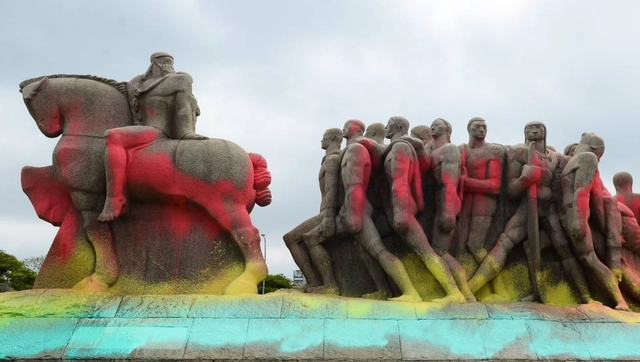
Monumento às Bandeiras, in São Paulo, covered in graffiti in 2016. Photo by Rovena Rosa / Agência Brasil / Fotos públicas
Architect Ayesha Luciano does not know much about her ancestors. Like other descendants of Afro-Brazilian and Indigenous populations, her family history was erased during the colonization of Brazil. This is what philosopher Sueli Carneiro calls epistemicide: the annihilation of knowledge and memories in countries with a history of slavery.
Yet the perpetrators of this genocide have their figures carved in stone, occupying central positions in the country's public spaces. Such is the case with the totemic statue of the bandeirante Borba Gato in the capital of São Paulo, or of Joaquim Pereira Marinho, a trafficker of enslaved people whose statue stands in the center of Salvador (BA). The architect comments:
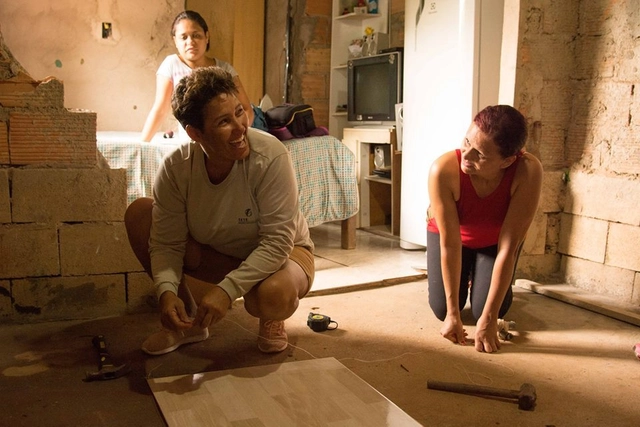
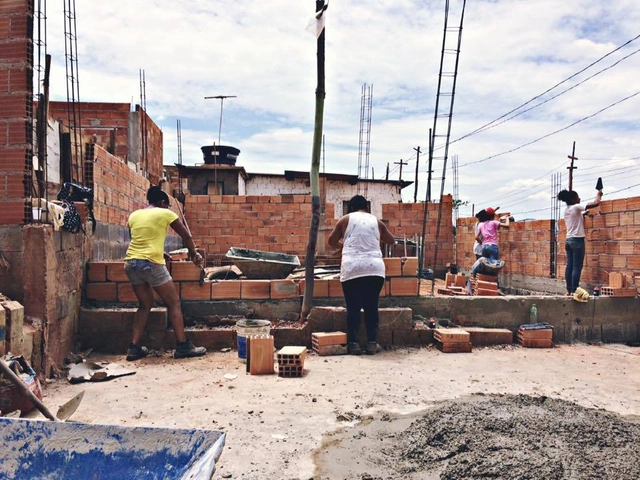
The spirit of the women who participate in the movements fighting for housing in Brazil is as hard as lime and wood. As a majority in land occupations, they vigorously coordinate organizational and political practices of settlement and popular housing construction. It is no wonder that many of the occupations of the MST (Landless Rural Workers' Movement) or the MTST (Homeless Workers' Movement) carry the names of women such as Dandara, a quilombo leader from the colonial period.
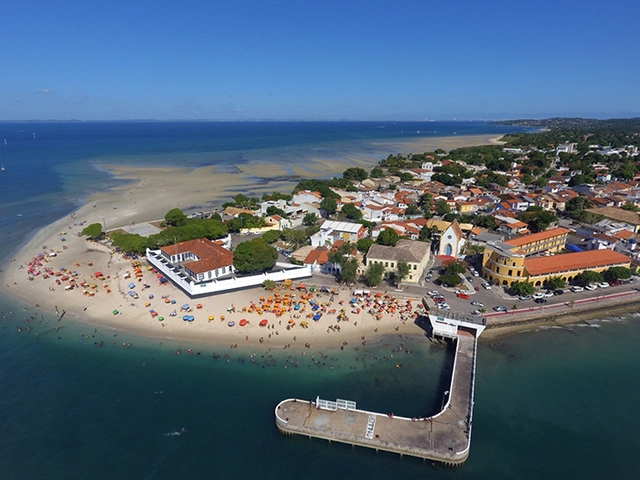
Municípios são territórios guardiões de cultura e identidade. Na foto, Itaparica (SP) / Foto: Wikipedia. Image Cortesia de Portal Aprendiz
Announced in November by Minister of Economy Paulo Guedes, the Mais Brasil Plan includes three Constitutional Amendment Proposals (PEC) aimed at balancing fiscal accounts at the federal, state, and municipal levels. Among them is the dissolution of municipalities that are not financially self-sustaining.
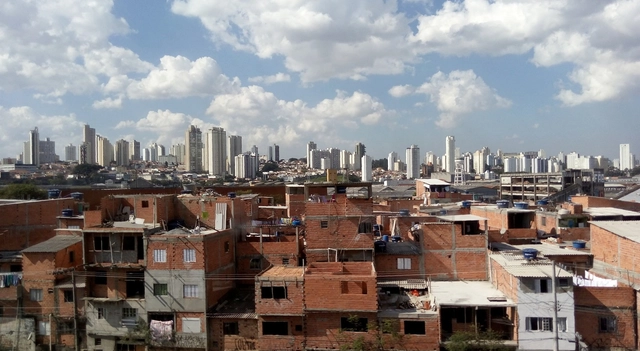
A person living in Moema, a neighborhood with one of the highest income concentrations in São Paulo, lives 20 years longer than someone born in Cidade Tiradentes, in the far east of the capital. Brazil's wealthiest city exposes just how unequal the country is, and how much access to public policies varies depending on where one lives.
The spirit of the women participating in housing rights movements in Brazil is remarkable. Predominantly active in land occupations, they vigorously coordinate the organizational and political practices of the settlements and the construction of popular housing. It is no coincidence that many occupations of the MST (Landless Workers' Movement) or the MTST (Homeless Workers' Movement) bear the names of women, such as Dandara, a leader from the colonial period.
The daily routine of psychologist and CAPS* (Psychosocial Care Center) coordinator Antoniella Santos Vieira centers on listening and walking: during the day, she listens to the stories of people experiencing homelessness, those struggling with alcohol and drug abuse, among other challenges. It is this challenging territory – half urban, half rural – that she traverses, showing that the center offers a range of services – such as yoga and pilates – in addition to psychological support.
Paraisópolis. Credit: Fernando Stankuns on Visual Hunt / CC BY-NC-SA
In 2018, anyone who passed by an empty lot in the heart of Paraisópolis—São Paulo's second-largest community—on Mondays and Thursdays encountered children with dirt-dusted knees, playing with objects like tires, paper boats, and twigs in endless games. This was the Brincreto project, an initiative by the Coletivo LUB – Laboratório de Urbano de Brincadeiras.
“Writing is like a city, for which words are a thousand gates.” - Walter Benjamin
No roads or maps lead to them. Yet, many of the cities imagined in literature feel more tangible than real ones, capturing the human imagination with their fantastical sparks. The rich geographical, cultural, and social detail of cities like the famous Macondo, from One Hundred Years of Solitude, frequently places a magnifying glass over the relationship between territory and its inhabitants.
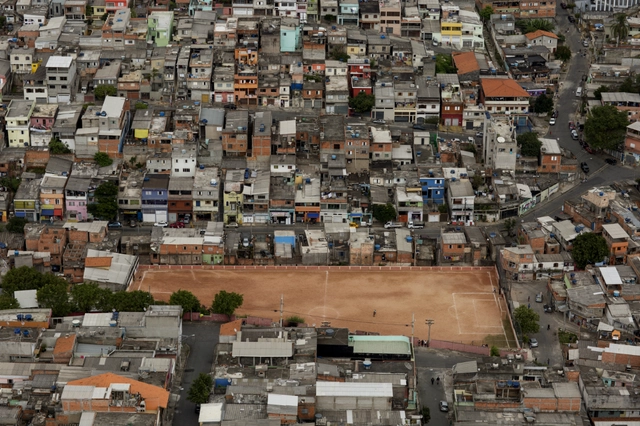
It was a city of untamed rivers: they seasonally burst their banks, shaping fertile, humid floodplains. When the waters receded, the ground became firm enough for a ball to roll and feet to run after it. It was in a São Paulo without rivers buried under sad slabs of concrete that futebol de várzea—floodplain football—emerged.
Tracing the history of várzea football in São Paulo means understanding how the city was built around imposing rivers like the Tietê. In the early 20th century, immigrant populations, Afro-Brazilians, and recently freed Black people occupied these territories, giving rise to neighborhoods like Barra Funda in the city's west zone. Far more than an amateur sport, it became established as a symbol of social organization and the struggle for the right to the city, at a time when space in the capital was beginning to be contested and feel the pressures of gentrification.





.jpg?1548078349&format=webp&width=640&height=580)